If press is good – is double press doubly good?
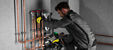
Press fittings are becoming more commonplace in the market. But with so many brands now available, what makes them different and which should you choose to provide the best reliability.
If press is good – is double press doubly good? If press is good – is double press doubly good?
Here’s the thing. Not all press connections are the same.
Unlike Europe, where press technology has been widely used for over 30 years, the UK has been relatively slow to adopt it. Contractors tend to lean into traditional welding technique and focus on anxiety about leaks associated with some early press fitting systems.
Not all press fittings systems are as reliable as they should be, and it pays to understand the difference before making a choice.
The basic principle of a press fitting for metal pipework is not in doubt. The pipe is inserted into the fitting, which includes an O ring (or sealing element). A press tool with the correct jaw profile is applied and the tool squeezes the outer metal sleeve with enough force to permanently reform the fitting around the pipe and the pipe is locked in place.
So far, so straightforward.
Where designs differ is in the degree of safety that is added into the system. A single press system is just that – relying on a single press point, typically at the end of the fitting, to achieve the permanent, leak-free result. This is commonly referred to as an M Profile.
It’s simple but has some vulnerabilities. This design can lead to uneven force distribution around the joint and potential weaknesses under vibration or thermal movement. In some cases, it also increases the risk of blow-offs if the fitting is not properly aligned or pressed.
For these reasons, Viega press connections are designed to be double pressed.
As the name implies, this means that there are two press points: one in front and one behind the sealing element, completed in a single pressing action with the Viega Pressgun. Known as a V Profile, this creates a robust, leak-proof connection that delivers both mechanical strength and seal reliability. So yes, we would say that double press is doubly good.
However, there is no ignoring the fact that when problems – and by problems, we basically mean leaks – occur, it is just as likely to be because of a faulty installation as a problem with the press technology.
Missing the press
Most common of all is the missed press. It’s going to happen sometimes. In a large installation, the team will be pressing tens, if not hundreds, of fittings in a day, often in a confined space and frequently in lighting conditions that are less than ideal. It really is all too easy to miss one.
Even if not pressed, a connection can look complete. The pipes are connected, and so the installation looks secure. Therefore, the contractor proceeds to test the system by running water through it at low pressure. It is critical that, if fitting has been missed, it leaks in an obvious way. At this low pressure test stage, immediate correction is possible with minimal intervention.
That’s where our SC-Contur design comes into its own. Designed with a unique leak path, the connections are designed to discharge visible amounts of water when tested at low pressure. The fact that all fittings can be tested at the same time from a central point, is an additional benefit.
The combination of double press design and the SC-Contur leak detection provides the most secure press fitting design on the market.
Press fitting systems is not all the same. Understanding the difference can avoid costly mistakes while capitalising on the huge time savings offered by the technology.
Stay ahead of the curve and never miss what matters. Get the latest industry trends, product innovations, and expert tips delivered straight to your inbox. Subscribe now and stay one step ahead with Viega.


-2%3Athumb-ultrawide "Paul Cocks")