Future-ready building with Viega
A solid foundation is essential for sustainability.
Sustainable building has become a key task for specialist planners, installers and operators. The increasing demands relating to CO₂ balances, material and energy consumption, and documentation require reliable data and long-lasting solutions. Viega supports you with transparent environmental product information and solutions designed for long service life. Together, we are laying the foundations for sustainable buildings.

Our areas of action

Innovative products and solutions
In product development, we consider aspects like product quality, expected service life and the use of resources. From the development stage, we work to reduce material use, increase recyclability, and incorporate recycled materials. This approach allows us to consider circular economy principles in product development and develop solutions for building applications.

Sustainable production
We continuously review our production processes with regard to energy and resource use. By investing in renewable energies and modern manufacturing technologies, we are taking steps to reduce CO₂e emissions from manufacturing our products. These steps include generating renewable electricity on site, phasing out combined heat and power units, electrifying production processes, and switching to electric heat supply. (Nachweis: NH Bericht)

Transparency and responsibility
Product and environmental data are playing an increasingly important role in construction projects. Around 90% of our portfolio is already covered by EPDs. We ensure that this data is easily accessible and straightforward to use, providing greater planning security and enabling reliable decision-making.
Sustainability never stops.
As a family business with a tradition spanning over 125 years, we act responsibly and with foresight. We take responsibility for our employees, our partners, and future generations. In product development, we consider aspects like product quality, cost-effectiveness, expected service life and the use of resources - supported by our Sustainable Product Analyser.
We view sustainability as an ongoing process. We review our structures, measure our progress and make this information transparent. By expanding our production capacities in Europe and establishing a new location in Germany, we are strengthening the regional economy, securing jobs, and ensuring stable supply chains. At the same time, we are investing in new technologies to ensure the continued availability of our products.

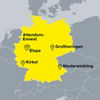
Production in Germany: close, stable, secure.
Viega has five manufacturing sites in Germany, which are centrally located in Europe and close to our customers, resulting in short distances. This creates stable supply chains, high delivery reliability and consistent quality.
Our first branch factory was established in Lennestadt-Elspe. Today, it is the competence centre for drainage technology, pre-wall systems and flushing systems, and has its own research and development centre. The success story of our metal press systems began in Attendorn-Ennest, home to one of the most modern foundries in Europe. Attendorn is also where the Viega Group originated, and where Viega World is located – one of the most modern training centres in Europe. With almost 1,000 employees, our plant in Großheringen is now our largest production hub and innovation centre, producing over 6,000 different product variants. Niederwinkling is renowned for its plastic pipe systems and efficient extrusion processes. We are also looking ahead: Viega continues to grow with the opening of our fifth site in Kirkel.
Transparency through EPDs
Viega offers durable, high-quality, recyclable products. Environmental Product Declarations (EPDs) make the environmental, health and resource impacts of our products transparent and visible in accordance with standards.
EPDs record the relevant environmental impacts of products throughout their entire life cycle, from the extraction of raw materials and their use to their disposal or recycling. This data is checked by independent bodies. This provides planners and specialist tradesmen with reliable information for planning, tendering and building assessments.

Tools such as Environmental Product Declarations (EPDs) are making the life cycle assessment of a product transparent and assessable. This data is becoming a crucial tool for planners, helping them to construct buildings that are demonstrably better and more sustainable.
Lukas Thelen (LCA & Product Sustainability Expert), Viega
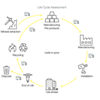
Understanding and using EPDs
-
What is an EPD?
An EPD (Environmental Product Declaration) helps planners and architects, for example, to assess the sustainability of buildings and construction projects. It shows how a product affects the environment throughout its entire life cycle – from raw material extraction and use to disposal or recycling. The aim of an EPD is to provide comparable data on product characteristics that affect the environment, resources and human health. These include, for example, global warming potential, acidification potential and primary energy demand. Planners use EPDs to compare products objectively and make sustainable decisions.
-
How are EPDs created?
An EPD is based on international standards. First, the Product Category Rules (PCR) define how a product should be assessed. The aim of the PCR is to enable similar products to be compared.
At the heart of the EPD is the life cycle assessment (LCA). This records the use of raw materials, energy, transport, emissions and waste throughout a product's entire life cycle. This enables the greenhouse gas emissions or resource consumption to be calculated, for example. The LCA is carried out in accordance with ISO 14040 and ISO 14044 standards.
The results are then incorporated into the EPD. This includes a brief description of the product and manufacturer, as well as clear environmental indicators broken down by life cycle stage. The data is checked by independent bodies before publication. The EPD is then made available on the programme holder's website or in official databases. In Germany, for instance, it is available in ÖKOBAUDAT.
-
What contribution do EPDs make to building certification?
EPDs are not certificates. However, they support sustainable planning and the certification process for buildings by providing reliable data on the environmental impact of construction products.
As well as life cycle assessment data, EPDs contain other information important for building certification, such as the composition, conformity and service life of materials. Depending on the assessment system used (e.g. DGNB, LEED or BREEAM), products with EPDs may be awarded a higher rating.
-
How long are EPDs valid?
EPDs are generally valid for five years. After that, they must be updated and recalculated.
-
Where can I download Viega's EPDs?
You can find them all here on the Viega website and on the following portals:
- Building Masterdata
- OXOMI
- ÖKOBAUDAT
- ift-Rosenheim
Open Datacheck also provides EPDs in the online systems used by specialist wholesalers, including direct product allocation.
-
What do Viega EPDs contain?
Our EPDs provide verified, machine-readable environmental data on Viega products. You can use this data for building certifications (e.g. DGNB, LEED). Viega does not issue certificates itself, but provides the necessary data.
-
What standards do Viega EPDs follow?
They comply with international standards such as ISO 14025 and the European standard EN 15804. They are based on life cycle assessments in accordance with ISO 14040/14044, and are verified by ift Rosenheim.
-
What information do EPDs provide on material compliance?
Our EPDs contain information on material conformity in two subchapters. The chapter 'Substances subject to declaration' contains a general statement on the REACH conformity of the respective product. This concerns compliance with the EU REACH regulation (Registration, Evaluation, Authorisation and Restriction of Chemicals). The chapter 'Emissions to the environment' shows whether and to what extent volatile organic compounds (VOCs) are released into indoor air.
However, EPDs generally assess environmental impacts, rather than legal or technical material compliance. The information on materials is used for life cycle assessment and does not replace proof of compliance.
-
Are EPDs mandatory (in the EU)?
No, they are not required by law. However, they are often required in tenders and certification systems.




%3Athumb-square)